

TL;DR:
- Effective A Level exam preparation relies on organized revision, evidence-based study techniques, and thorough exam-day planning. Students should confirm exam logistics, gather core resources, and practice active recall with spaced repetition for better retention. Proper logistical preparation and understanding mark schemes are essential to maximize confidence and exam performance.
Effective A Level exam preparation is defined by three pillars: organised revision, evidence-based study techniques, and thorough exam-day readiness. Knowing how to prepare for A Level exams separates students who feel confident walking into the hall from those who feel they have left things to chance. 73% of UK students are not actively engaged in learning. That statistic reflects a real problem with how most students revise, not how capable they are. This guide gives you a clear, practical framework built on official Ofqual 2026 guidance and methods used by Oxbridge graduates.
What should you confirm before you start revising?
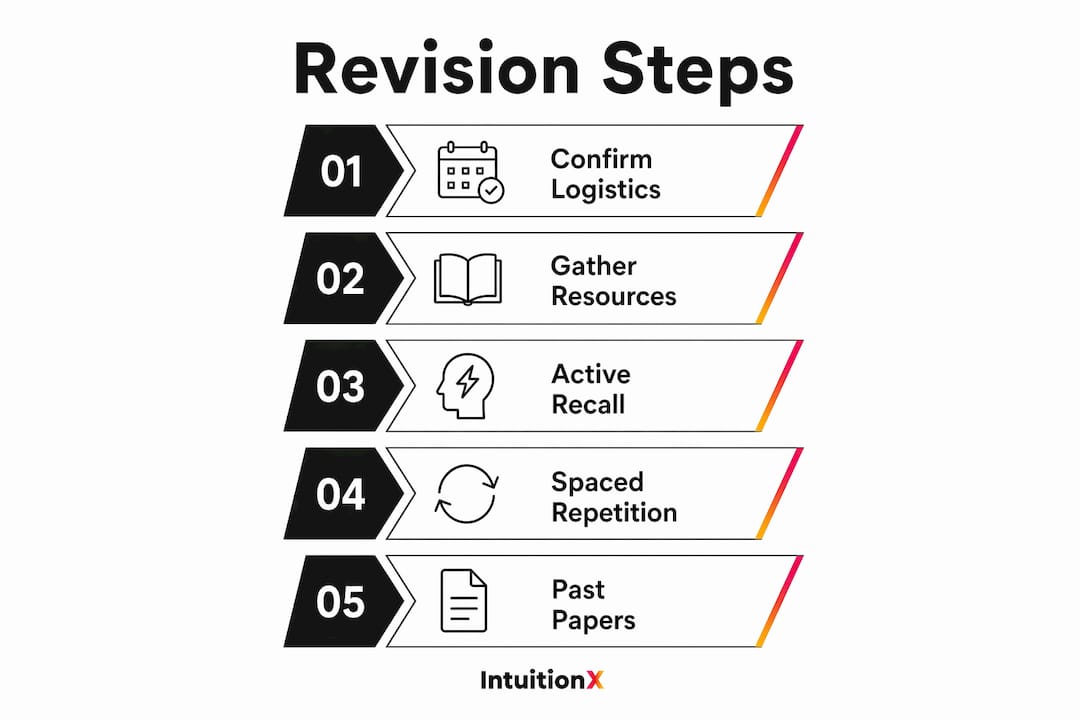
Preparation is as much about confirming exam logistics and rules as it is about academic revision. Students who skip this step often face avoidable surprises on exam day. Sort these fundamentals first, then build your revision plan on top of them.
Your syllabus, timetable, and permitted equipment
Use your syllabus as a checklist to track every topic and subtopic honestly. This prevents the common trap of over-revising comfortable material while neglecting weak areas. Print it out and tick off each section as you cover it with genuine confidence, not just familiarity.
Confirm your exam timetable, location, and permitted equipment with your teacher or exams officer before revision begins. Check the timetable carefully for clashes or errors. A single scheduling mistake can cost you an entire sitting.
Know exactly what equipment each exam allows. The table below summarises the key rules at a glance.
| Item | Status |
|---|---|
| Approved calculator | Permitted in specified subjects |
| Pens, pencils, ruler | Always permitted |
| Mobile phone | Never permitted, even switched off |
| Smartwatch or wearable device | Never permitted |
| Water bottle (plain, no label) | Usually permitted |
| Revision notes | Never permitted |
No electronics are allowed in the exam hall, even if switched off. Taking a phone in risks disqualification from that paper. Hand devices in at your exam centre using their official process before you enter.
Gathering your core resources
Collect your core resources before revision starts: subject textbooks, revision guides, and past papers. For A Level sciences, CGP revision guides are widely used and cover AQA, OCR, and Edexcel specifications. For humanities, Philip Allan revision guides are a reliable choice. Past papers are available free on the AQA, OCR, and Edexcel websites. Download at least five years' worth for each subject.
How can you structure revision using active recall and spaced repetition?
Active recall and spaced repetition significantly improve A Level revision effectiveness compared to passive re-reading. Re-reading notes feels productive but produces weak memory traces. Active recall forces your brain to retrieve information, which is the mechanism that actually builds long-term retention.

Active recall techniques that work
The three most effective active recall methods for A Level students are flashcards, blurting, and practice questions.
- Flashcards: Write a question on one side and the answer on the other. Test yourself without looking. Use Anki, a free spaced repetition app, to automate the scheduling of card reviews.
- Blurting: Close your notes and write down everything you can recall about a topic on a blank page. Then open your notes and fill in the gaps in a different colour. The gaps show you exactly where to focus next.
- Practice questions: Answer past paper questions from memory, then mark your own work against the mark scheme. This combines active recall with examiner awareness.
Pro Tip: Set a timer for 20 minutes per active recall session. Short, focused bursts produce better retention than long, unfocused study blocks.
Spaced repetition and your revision timetable
Spaced revision exploits memory mechanisms by extending intervals between recalls, building durable knowledge. The principle is simple: revisit a topic after one day, then three days, then a week, then a fortnight. Each revisit reinforces the memory trace before it fades.
Effective revision timetables must balance fixed commitments and weak topic prioritisation with built-in flexibility to manage overruns. Block your weakest topics into the earliest revision slots. Leave buffer time at the end of each week for topics that took longer than planned. A rigid timetable that you abandon by week two is worse than a flexible one you actually follow.
Mix subjects within a single study day. Switching between, say, Biology and History prevents the mental fatigue that comes from spending six hours on one subject. Variety sustains focus and mirrors the way spaced repetition works across different knowledge domains.
What is the best way to use past papers and mark schemes?
Practising with past papers under timed conditions and studying mark schemes are the single most effective way to understand what examiners actually want. Most students use past papers too late and too casually. The progression below fixes that.
Open-book to timed: a three-stage approach
| Stage | Conditions | Purpose |
|---|---|---|
| Stage 1: Open-book, untimed | Notes available, no time pressure | Understand method and structure |
| Stage 2: Closed-book, untimed | No notes, no time pressure | Build recall without time stress |
| Stage 3: Closed-book, timed | Full exam conditions | Simulate the real exam accurately |
Start at Stage 1 early in your revision. Move to Stage 3 in the final four weeks before your exam. Skipping straight to timed papers before you understand the method builds anxiety without building skill.
How to use mark schemes properly
Learn examiners' mark schemes carefully to understand how marks are allocated and what examiners expect. Misunderstanding mark schemes leads to avoidable mark loss even when you know the material well. That is one of the most frustrating outcomes in A Level exams.
Read the mark scheme before you mark your own answer. Identify the exact phrases and structures that earn marks. Pay close attention to command words: "describe" requires different content from "explain," and "evaluate" requires a different structure from "analyse." Practise writing answers that mirror the mark scheme's language and logic.
Pro Tip: After marking a past paper, write a one-sentence summary of every mark you lost and why. Review that list before your next practice session. Patterns in your errors are your fastest route to improvement.
Work through at least five years of past papers per subject. Pattern recognition across multiple years builds genuine confidence and reveals the topics examiners return to repeatedly. For proven study strategies that complement past paper work, the Intuitionx blog covers these in detail.
What should you do the day before and the day of your exam?
The evening before your exam is not for learning new content. It is for logistics and calm preparation.
The night before: your checklist
Prepare your exam equipment the night before and aim to arrive at the venue 20–30 minutes early to reduce stress. Pack your bag the night before using this checklist:
- Two or more black ballpoint pens
- Pencils, rubber, and ruler
- Your approved calculator (check the battery)
- Photo ID if required by your centre
- A clear water bottle with no label
- Your exam timetable with the room location
Leave your phone, smartwatch, and any revision notes at home or hand them in at the centre's designated point. Do not rely on remembering to do this at the door.
Stop active revision by 8pm the evening before. After that, limit any review to a light glance at key formulae or a brief summary page. Heavy revision the night before overloads working memory and increases anxiety without adding meaningful knowledge.
On the day: managing your time in the hall
"Read the full paper before you write a single word. Allocate your time per question based on marks available. Never spend 20 minutes on a 4-mark question."
Arrive early, find your seat, and read the instructions on the front of the paper carefully. If you feel anxious, take three slow breaths before you begin. Anxiety is normal. It does not predict your result. For techniques to manage exam stress effectively, the Intuitionx guide on study anxiety is worth reading before exam season begins.
Key takeaways
Effective A Level exam preparation requires combining honest syllabus tracking, active recall techniques, progressive past paper practice, and careful exam-day logistics to maximise both knowledge and confidence.
| Point | Details |
|---|---|
| Confirm logistics first | Check your timetable, location, and permitted equipment with your exams officer before revising. |
| Use active recall, not re-reading | Flashcards, blurting, and practice questions build stronger memory than passive note review. |
| Progress through past paper stages | Move from open-book to fully timed conditions over several weeks, not days before the exam. |
| Study mark schemes closely | Understanding how marks are allocated prevents avoidable losses on content you already know. |
| Prepare equipment the night before | Pack your bag and stop heavy revision by 8pm to arrive calm and ready. |
What I have learned from watching students prepare
I have seen students with genuinely strong subject knowledge underperform because they ignored the logistics side of preparation. They walked into the wrong room, forgot a calculator, or lost marks because they had never read a mark scheme properly. The content knowledge was there. The preparation framework was not.
The most honest piece of advice I can offer is this: treat your syllabus like a contract. Every topic on it is a promise the examiner has made to you about what they will test. If you have not covered it, you are leaving marks on the table by choice. Oxbridge graduates who revised with a syllabus checklist consistently report that it changed how they allocated revision time.
Set realistic daily goals. Three focused hours of active recall beats eight hours of passive re-reading every time. Build in breaks. Take a walk. Sleep properly. Your brain consolidates memory during sleep, so cutting sleep to revise more is a trade-off that rarely pays off.
Talk to your teachers and exams officer when you are unsure about anything. They want you to succeed. Asking a question about permitted equipment or exam structure is not a sign of weakness. It is the kind of preparation that removes stress before it builds.
— Angus
How Intuitionx supports your A Level revision
A Level preparation works best when you have a thinking partner who challenges you to recall, not just re-read.

Intuitionx is a 24/7 Socratic AI tutor built on the knowledge of academics who earned A*s at A Level and Firsts from Oxford and Cambridge. Its core AI, Omniscience, uses pedagogical methods grounded in memory science to ask the right questions at the right time, turning passive study into active learning. Sir Anthony Seldon, described by the BBC as "one of Britain's leading educationalists," has backed Intuitionx directly. Whether you need help structuring a personalised revision plan or want to practise past paper questions with instant, expert-level feedback, Intuitionx is built for exactly this moment in your studies.
FAQ
What is the most effective A Level revision technique?
Active recall is the most effective technique for A Level revision. Methods like flashcards, blurting, and timed practice questions produce stronger long-term memory than re-reading notes.
How far in advance should I start A Level exam preparation?
Starting structured revision at least 10–12 weeks before your first exam gives you enough time to cover all topics, practise past papers progressively, and address weak areas without cramming.
Can I take my phone into the A Level exam hall?
No. Official Ofqual guidance states that mobile phones and smartwatches are not permitted in the exam hall, even if switched off. Taking one in risks disqualification.
How many past papers should I complete per subject?
Completing at least five years of past papers per subject is recommended. This builds pattern recognition and familiarises you with the range of question styles examiners use.
What should I do if I feel anxious on exam day?
Arrive 20–30 minutes early, read the full paper before writing, and allocate time per question based on marks. Controlled breathing before you begin reduces acute anxiety without requiring any preparation the night before.