

TL;DR:
- Parents can positively influence their teenager’s exam readiness through collaborative revision planning, sleep protection, and calm support. Active study methods, like self-testing and past papers, outperform passive re-reading, enhancing retention and exam performance. Overinvolved or anxious parents risk increasing stress and undermining their teenager’s confidence and mental wellbeing.
The exam preparation process for parents is defined as the structured involvement of parents in planning, supporting, and sustaining their teenager's revision from the first study session through to exam day. Getting this right matters more than most parents realise. 73% of UK students are not actively engaged in learning, and exam anxiety compounds that disengagement fast. The good news is that your involvement, done well, directly improves both your teenager's academic performance and their mental wellbeing. This guide gives you a clear, research-backed roadmap covering revision planning, stress management, effective study techniques, and how to support without smothering.
What are the essential steps in the exam preparation process parents should follow?

The most effective starting point is checking the official exam board specifications before your teenager opens a single textbook. Exam boards such as AQA, Edexcel, and OCR publish full specifications, past papers, and mark schemes for every subject. Using these materials reduces last-minute stress and builds genuine confidence because your teenager knows exactly what will be tested.
Once you have the specifications, build a revision timetable together. The key word is together. A timetable imposed by a parent gets ignored. One built collaboratively gets used.
A realistic timetable should include:
- One subject per session, not multiple topics crammed together
- Sessions of no more than 30 minutes of focused work before a short break
- At least one full rest day per week
- Scheduled time for exercise, meals, and social contact
Pro Tip: A University of Sheffield study cited by The Good Schools Guide recommends 30-minute focused sessions over long, unbroken hours. Short bursts with breaks outperform marathon study every time.
Variety in revision methods matters as much as the timetable itself. Encourage your teenager to mix written notes, videos, self-quizzing, and flashcard tools such as Quizlet or Anki. Passive re-reading of notes is the least effective method available. Active recall, where your teenager tests themselves without looking at the material, produces far stronger retention.
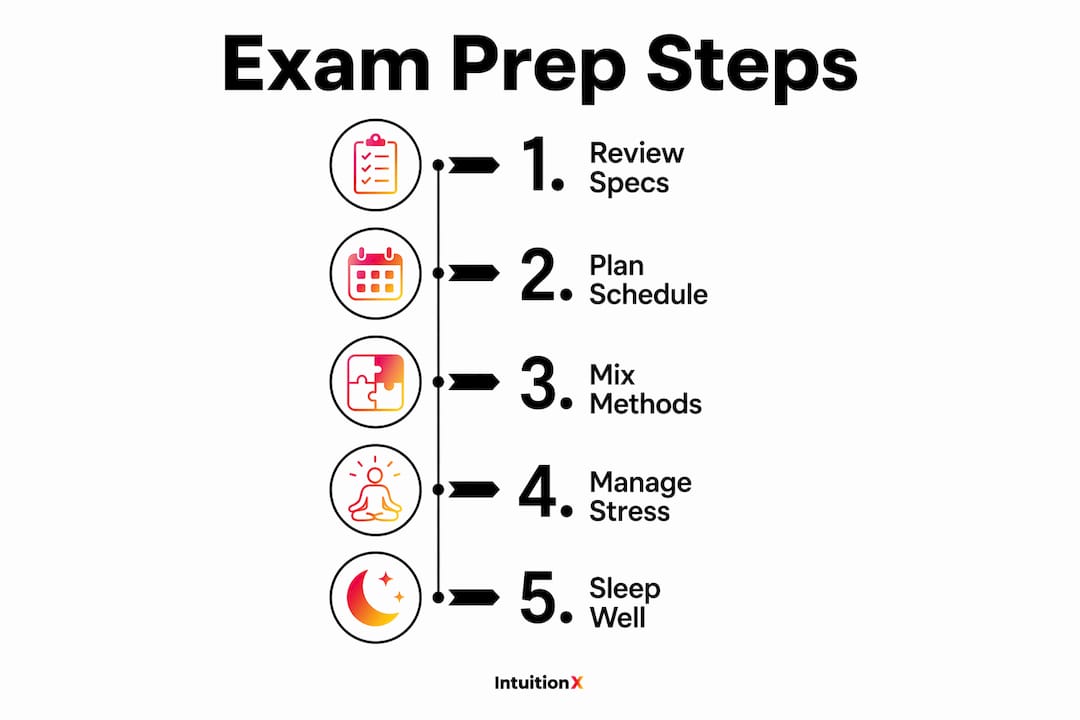
Finally, set up a study environment that removes distractions. A clear desk, phone in another room, and a consistent study space signal to the brain that it is time to focus. These small physical cues make a measurable difference to concentration.
How can parents help manage exam stress and protect their teenager's sleep?
Academic stress is not just an emotional inconvenience. A 2026 study published in Frontiers in Psychology found a strong link between academic stress and poor psychological health, with sleep quality acting as the critical mediating factor. When sleep suffers, so does everything else: memory, mood, and exam readiness all decline together.
The single most counterproductive habit parents and teenagers share is late-night cramming. Research is clear that late-night studying harms sleep quality in ways that directly undermine the next day's performance. Protecting a consistent bedtime is not a luxury. It is a revision strategy.
Practical steps to reduce exam-related stress at home:
- Hold calm, brief check-ins rather than lengthy interrogations about revision progress
- Avoid comparing your teenager's preparation to siblings or classmates
- Acknowledge effort openly, not just results
- Keep mealtimes screen-free and conversation-led
- Encourage at least 30 minutes of physical activity each day
"Improving adolescents' sleep quality buffers the psychological impact of academic stress on exam readiness." — Frontiers in Psychology, 2026
The role of exercise and social time is frequently underestimated. A teenager who takes a 45-minute walk or sees a friend for an hour returns to revision more focused, not less. Downtime is not wasted time. It is recovery, and recovery is part of the preparation.
Pro Tip: Set a household rule that all devices, including your own, go off 60 minutes before your teenager's bedtime during exam season. Modelling the behaviour makes it far easier for them to follow.
Which study techniques should parents encourage for better retention?
Active learning methods consistently outperform passive ones. The shift from re-reading to self-testing is the single biggest improvement most teenagers can make to their revision. Tools like Quizlet and Anki use spaced repetition, a method that spaces out review sessions over time to move information from short-term to long-term memory.
Here is a direct comparison of passive versus active revision methods:
| Method | Type | Effectiveness |
|---|---|---|
| Re-reading notes | Passive | Low retention |
| Highlighting textbooks | Passive | Low retention |
| Self-testing with flashcards | Active | High retention |
| Spaced repetition (Quizlet, Anki) | Active | High retention |
| Answering past paper questions | Active | Very high retention |
| Teaching a topic aloud | Active | Very high retention |
The most effective single technique is answering past paper questions under timed conditions. This builds both knowledge and the exam-specific skill of working under pressure. Encourage your teenager to mark their own answers using official mark schemes. That self-assessment process deepens understanding faster than simply reading a model answer.
Four active revision steps to encourage:
- Close the notes and write down everything remembered about a topic from memory
- Use Quizlet or Anki to create subject-specific flashcard decks
- Complete one past paper question per revision session, then mark it honestly
- Ask "why does this happen?" and "how does this connect to what I already know?" after every new concept
Mixing up subjects across the week also helps. Studying the same subject for three consecutive days leads to diminishing returns. Alternating between subjects keeps the brain engaged and reduces the mental fatigue that comes from repetition. For subject-specific revision strategies, evidence-based revision methods are worth exploring alongside the techniques above.
How should parents balance support without adding pressure?
Parental encouragement without pressure improves study motivation and reduces exam anxiety. Calm, consistent support from parents, rather than hovering or interrogating, is what actually helps teenagers perform better. The distinction between support and pressure is not always obvious, but your teenager feels it immediately.
Respecting your teenager's study rhythm is non-negotiable. Some teenagers work best in the morning. Others only hit their stride after 7pm. Forcing a schedule that conflicts with their natural rhythm creates resistance, not productivity. A flexible revision timetable tailored to their learning style produces far more consistent results than one imposed from outside.
Signs that parental involvement has tipped into pressure:
- Your teenager becomes defensive or withdrawn when revision is mentioned
- Arguments about study time become a daily occurrence
- They report feeling that nothing they do is ever enough
- They stop sharing how they are feeling about exams altogether
When you notice these signs, step back. Offer a conversation about how they are feeling rather than how much they have revised. The research is clear that study habits positively affect exam readiness, while anxiety negatively affects it. Reducing anxiety is as important as increasing study time.
Realistic expectations also matter. Not every teenager will achieve top grades, and that is genuinely fine. Your job is to create the conditions for your teenager to do their personal best, not to engineer a specific outcome. That shift in framing, from outcome to effort, reduces household tension and actually improves performance. For a deeper look at the parental role in exam prep, supporting your teen's A Level preparation covers this balance in detail.
Key takeaways
Effective parental support in the exam preparation process combines structured revision planning, sleep protection, active study techniques, and calm encouragement, all working together to improve both performance and wellbeing.
| Point | Details |
|---|---|
| Start with official resources | Check AQA, Edexcel, or OCR specifications and past papers before revision begins. |
| Build the timetable together | Collaborative timetables with 30-minute sessions and rest days get used consistently. |
| Protect sleep above all else | Sleep quality mediates the link between academic stress and psychological health. |
| Prioritise active revision | Self-testing, past papers, and spaced repetition tools like Quizlet outperform re-reading. |
| Support without hovering | Calm encouragement reduces anxiety; pressure and micromanaging increase it. |
What I have learned from watching families get this wrong
Parents almost always care deeply. That is never the problem. The problem is that caring deeply, without a clear framework, tips into anxiety, and anxious parents create anxious teenagers. I have seen this pattern repeatedly: a parent who checks in five times a day about revision progress genuinely believes they are helping. Their teenager experiences it as surveillance.
The research backs up what I have observed. Exam anxiety has a measurable negative effect on readiness, while good study habits have a measurable positive one. The implication is uncomfortable but clear. If your involvement is raising your teenager's anxiety, it is actively working against their performance, regardless of your intentions.
What actually works is quieter than most parents expect. It is keeping the fridge stocked, the house calm, and the conversations warm but not revision-obsessed. It is asking "how are you feeling?" more often than "how much have you done?" It is trusting that the timetable you built together is being followed, even when you cannot see it happening.
The parents I have seen get this right share one trait: patience. They accept that their teenager's revision process will not look exactly like theirs did, or like what they imagined it would look like. They focus on building confidence rather than monitoring compliance. That shift, from compliance to confidence, is where the real results come from.
— Angus
How Intuitionx supports parents and teenagers during exam season
Intuitionx is a 24/7 AI tutor built on Oxbridge-level pedagogy, designed to give every teenager access to the kind of thinking partnership that was previously reserved for those whose families could afford £100-per-hour private tutors.

For parents, that means your teenager has a knowledgeable, patient study companion available at any hour, one that uses Socratic questioning to deepen understanding rather than simply handing over answers. Backed by Sir Anthony Seldon, described by the BBC as "one of Britain's leading educationalists", Intuitionx helps teenagers build real study skills rather than bypassing the learning process entirely. You can give your teenager access to Intuitionx today and let the preparation begin in earnest.
FAQ
What is the most effective revision session length for teenagers?
Research cited by The Good Schools Guide recommends 30-minute focused sessions with regular breaks. Shorter, concentrated study outperforms long, unbroken hours for both retention and motivation.
How does sleep affect exam performance?
A 2026 Frontiers in Psychology study found that sleep quality directly mediates the relationship between academic stress and psychological health. Poor sleep reduces memory consolidation, mood, and exam readiness simultaneously.
Which revision tools are most effective for active learning?
Quizlet and Anki use spaced repetition to move information into long-term memory. Answering past paper questions under timed conditions is the single most effective technique for exam-specific preparation.
How much should parents be involved in their teenager's revision?
Calm, consistent encouragement improves motivation and reduces anxiety. Daily interrogation about revision progress tips into pressure, which research shows negatively affects exam readiness.
When should parents start the exam preparation process?
Starting six to eight weeks before exams allows time to cover all subjects without cramming. Checking official exam board specifications at the outset ensures revision targets the right content from day one.