

TL;DR:
- Lifelong learning involves the ongoing pursuit of knowledge and skills across all stages of life and various environments. It enhances employability, cognitive resilience, and societal inclusion, especially in rapidly changing economies. Overcoming systemic barriers like credential fragmentation and digital divides requires collaborative, inclusive policies to ensure equitable access for all learners.
Lifelong learning is defined as the continuous, voluntary pursuit of knowledge and skills throughout a person's life, extending well beyond formal schooling into every stage of adulthood and professional development. Recognised by organisations including UNESCO and the International Labour Organization, it spans formal education, non-formal community programmes, and informal daily experiences. The definition of lifelong learning matters now more than ever: fewer than 5% of adults globally have access to formal learning opportunities, yet the demand for new skills has never been greater. Whether you are a student, an educator, or a professional navigating a shifting job market, understanding what lifelong learning means, and how to practise it, is one of the most useful things you can do in 2026.
What are the key benefits of lifelong learning?

Lifelong learning directly supports employability, cognitive resilience, and social inclusion across every career stage. The ILO identifies it as critical for workforce resilience amid rapid digital, green, and demographic transitions. That means if your industry is changing, and most are, continuous learning is not optional. It is the mechanism by which individuals stay relevant and productive.
The personal benefits are equally significant. Regular learning strengthens memory, sharpens problem-solving, and builds the kind of adaptability that no single qualification can provide. Social skills improve too, particularly when learning happens in collaborative environments like community courses or workplace training cohorts.
"Without inclusive, quality learning access, labour inequalities risk worsening, especially among informal workers." — ILO World of Work Series
The societal case is just as compelling. Consider these realities:
- 754 million adults currently lack basic literacy, making access to lifelong learning a matter of equity, not just ambition.
- Lifelong learning mitigates labour-market inequalities and supports disadvantaged workers who are most vulnerable to automation and economic disruption.
- Communities with higher rates of adult learning show stronger civic participation and lower unemployment over time.
- Continuous skill development contributes to national productivity, particularly in economies undergoing green and digital transitions.
The importance of lifelong learning, then, is not abstract. It shapes who gets ahead, who gets left behind, and how resilient entire societies become in the face of change.
How does lifelong learning occur in different environments?
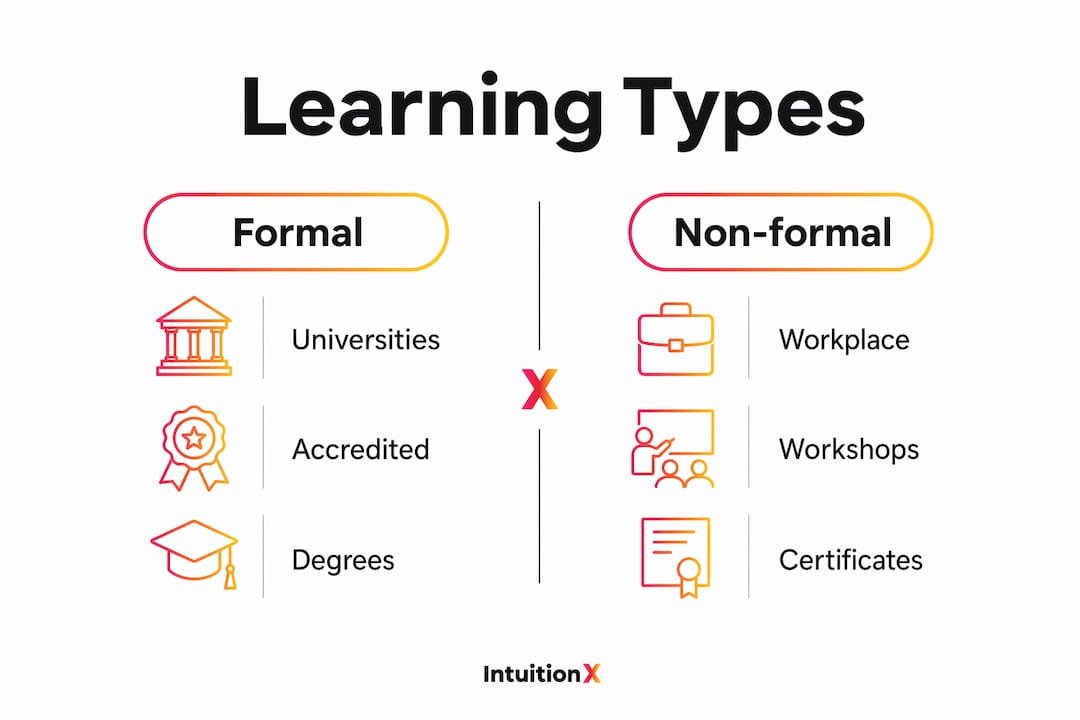
Lifelong learning encompasses formal, non-formal, and informal learning continuing well beyond traditional schooling. Each mode is distinct, but they work best when they reinforce one another.
Formal learning refers to structured, accredited education delivered by recognised institutions. Think university degrees, professional certifications, and accredited online courses. It carries credential weight but is often expensive, time-consuming, and inaccessible to many adults.
Non-formal learning sits outside the official curriculum but is still organised and intentional. Workplace training programmes, community language classes, coding bootcamps, and employer-led upskilling schemes all fall here. These are often more flexible and directly tied to practical outcomes.
Informal learning is the most pervasive and least recognised type. It happens through reading, watching documentaries, peer conversations, on-the-job problem-solving, and digital platforms. Most adults are already doing it without labelling it as learning at all.
| Learning type | Setting | Structure | Credential |
|---|---|---|---|
| Formal | Universities, colleges | Highly structured | Accredited qualification |
| Non-formal | Workplaces, community centres | Organised but flexible | Certificate or none |
| Informal | Daily life, digital platforms | Self-directed | Rarely recognised |
Recognising all three types matters enormously for building inclusive learning systems. When policymakers and employers only reward formal credentials, they ignore the vast majority of learning that actually happens. Micro-credentials and credit banks are beginning to address this gap, helping to validate diverse skills acquired across different contexts.
Pro Tip: Keep a simple learning log, a notebook or a notes app will do, where you record what you have learnt each week across all three modes. You will quickly see how much informal learning you are already doing, and where the gaps are.
What challenges affect access to lifelong learning?
Lifelong learning systems are often fragmented, limiting learner mobility and making it difficult to transfer credentials between institutions or sectors. This is one of the most underappreciated barriers to continuous education. A qualification earned in one country or through one provider frequently carries no weight elsewhere, discouraging learners from investing in non-traditional pathways.
The barriers go deeper than paperwork. Socio-economic divides mean that workers in lower-income brackets have less time, money, and employer support for learning. Geographic isolation cuts off rural communities from quality provision. The digital divide compounds everything: without reliable internet access or device ownership, digital learning platforms remain out of reach for millions.
Addressing these challenges requires deliberate action at multiple levels:
- Policy agility. Agile, data-driven policies that respond quickly to shifting economic demands are more effective than rigid, decade-long education frameworks. Governments need to iterate, not just legislate.
- Credential portability. Micro-credentials and national credit frameworks allow learners to accumulate and transfer recognised learning across providers and borders, reducing the cost of switching pathways.
- Employer investment. Organisations that fund and schedule learning time for employees see stronger retention and productivity. Learning cannot be purely the individual's responsibility.
- Stakeholder collaboration. Effective lifelong learning systems require coordination between governments, employers, educational institutions, and community organisations. No single actor can solve this alone.
- Inclusive design. Programmes built without input from disadvantaged learners tend to serve them poorly. Co-designing learning opportunities with the communities they are meant to reach produces better outcomes.
Pro Tip: If you are an educator or HR professional, audit your current learning provision against these five points. Most organisations are strong on one or two and weak on the rest. That gap is where your learners are falling through.
How can you engage effectively in lifelong learning?
The most practical shift any learner can make is adopting a skills-first mindset. A skills-first approach focuses on competency validation rather than traditional credentials, enabling quicker job advancement and greater adaptability. Instead of asking "what qualification do I need?", ask "what can I demonstrably do?" That reframe changes everything about how you choose what to learn next.
Here are the most effective lifelong learning strategies for individuals in 2026:
- Blend theory with practice. Combining classroom instruction with work-based experience produces better learning outcomes than theory alone. Apply what you learn within days of learning it, not months.
- Use digital platforms deliberately. Platforms offering structured courses, Socratic dialogue, or spaced repetition are far more effective than passive content consumption. Watching a YouTube video is not the same as actively working through a problem.
- Set specific learning goals. Vague intentions like "I want to learn more about data" rarely lead anywhere. Specific goals, such as "I will complete a Python fundamentals module by the end of this month," create accountability.
- Tap community resources. Libraries, professional associations, local colleges, and employer training budgets are all underused. Many offer free or subsidised access to high-quality learning.
- Practise self-directed learning. Taking ownership of your own learning schedule, pace, and content selection is the defining habit of successful lifelong learners.
Personalised learning approaches also make a measurable difference. When learning is tailored to your existing knowledge, preferred pace, and specific goals, retention improves and motivation stays higher for longer. Generic one-size-fits-all content is the enemy of genuine progress.
Key takeaways
Lifelong learning is the continuous, voluntary pursuit of knowledge across formal, non-formal, and informal settings, and it is the single most reliable strategy for staying relevant in a rapidly changing world.
| Point | Details |
|---|---|
| Clear definition matters | Lifelong learning spans all ages and settings, not just formal education after school. |
| Benefits are personal and societal | It supports employability, cognitive resilience, and reduces labour-market inequality. |
| Three learning modes exist | Formal, non-formal, and informal learning each play a distinct and complementary role. |
| Systemic barriers are real | Fragmented credentials, digital divides, and socio-economic gaps limit access for millions. |
| Skills-first beats credentials-first | Focusing on demonstrable competencies accelerates career progression and adaptability. |
Why lifelong learning is the defining habit of our era
I have spent years watching people treat learning as something that happens in a classroom and stops at graduation. That assumption is now genuinely dangerous. The pace of change in technology, labour markets, and social structures means that a qualification earned five years ago may already be partially obsolete. The people I see thriving are not necessarily the most credentialled. They are the most curious and the most consistent.
What strikes me most about the current moment is how the barriers to learning have shifted. The problem is no longer access to information. Information is everywhere. The real problem is knowing what to learn, how to learn it effectively, and how to stay motivated when no one is grading you. That is where most adults quietly give up.
The concept of a Learning Society is not just an academic idea. It is a practical vision in which learning becomes as embedded in daily life as eating or exercising. We are not there yet, but the infrastructure is being built. Micro-credentials, AI tutoring, open digital platforms, and employer-led upskilling are all pieces of the same puzzle.
My honest view is that the learners who will thrive in the next decade are those who stop waiting for someone to hand them a curriculum and start building one for themselves. The tools exist. The question is whether you will use them.
— Angus
Start your lifelong learning journey with Intuitionx
Intuitionx is built for exactly this moment. As a 24/7 Socratic AI tutor with Oxbridge-level intelligence, it gives every learner access to the kind of personalised, rigorous learning that was once reserved for those who could afford £150-an-hour private tutors. Whether you are a student trying to build real understanding, a professional upskilling between jobs, or an educator looking for tools that actually work, Intuitionx meets you where you are. Sir Anthony Seldon, described by the BBC as one of Britain's leading educationalists, put it plainly: "If you are serious about staying ahead in the age of AI, try IntuitionX today." Start learning now and see what learning like the 1% actually feels like.
FAQ
What is the definition of lifelong learning?
Lifelong learning is the continuous, voluntary pursuit of knowledge and skills throughout a person's life, spanning formal education, non-formal training, and informal daily experiences. UNESCO and the ILO both recognise it as a fundamental driver of personal development and economic resilience.
Why is lifelong learning important in 2026?
Rapid digital, green, and demographic transitions mean that skills acquired years ago can quickly become outdated. The ILO identifies lifelong learning as critical for workforce resilience, employability, and reducing labour-market inequality in modern economies.
What are the main types of lifelong learning?
The three main types are formal learning (accredited qualifications from institutions), non-formal learning (organised but flexible programmes such as workplace training), and informal learning (self-directed activity through daily life and digital platforms).
How do I start engaging in lifelong learning as an adult?
Adopt a skills-first mindset, set specific learning goals, and blend structured courses with practical application. Digital platforms, community resources, and employer training budgets are all accessible starting points for lifelong learning in adulthood.
What is the biggest barrier to lifelong learning?
Fragmented learning systems with poor credential recognition remain the most systemic barrier, according to the ILO. Socio-economic divides and the digital divide compound this, limiting access for the adults who would benefit most.