

TL;DR:
- Effective study for teens relies on cognitive science principles, emphasizing active retrieval and spaced repetition over passive review. Techniques like the Pomodoro Method, atomic flashcards, and the Feynman Technique significantly enhance understanding and memory when used consistently. Parents can support by encouraging self-explanation, asking about learning rather than study duration, and fostering self-management skills.
Most teens spend hours studying and still underperform in exams. The problem is rarely effort. It is method. The right study techniques for teens are grounded in cognitive science, not habit or guesswork. Yet most students default to highlighting and rereading because it feels productive. It is not. This article cuts through the noise and gives you a practical, research-backed toolkit. Whether you are a teen preparing for GCSEs or A Levels, or a parent trying to support without micromanaging, you will find techniques here that genuinely change outcomes.
Table of Contents
- Key takeaways
- What makes a study technique worth using
- 1. Retrieval practice: the most powerful tool you have
- 2. The Pomodoro Technique: focus in timed blocks
- 3. Spaced repetition: studying smarter over time
- 4. Atomic flashcards: one idea, one card
- 5. The Feynman Technique: teach it to learn it
- 6. Self-generated questions: active engagement with content
- 7. Comparing the techniques: what to use and when
- 8. Building your personalised study plan
- 9. Tools and resources to support effective study
- My honest take on what actually makes the difference
- How Intuitionx can take your study further
- FAQ
Key takeaways
| Point | Details |
|---|---|
| Active recall beats passive review | Self-testing and retrieval practice build stronger memory than rereading or highlighting. |
| Spaced repetition prevents forgetting | Reviewing material at optimised intervals locks information into long-term memory. |
| Pomodoro improves focus | Working in 25-minute timed blocks with proper breaks protects attention and reduces fatigue. |
| One idea per flashcard | Atomic flashcards force genuine retrieval rather than passive recognition. |
| Combine techniques for best results | Mixing active recall, problem-solving, and teaching deepens understanding across subjects. |
What makes a study technique worth using
Not all study techniques are equal. Before you adopt any method, it helps to know what separates a technique that sticks from one that just fills time.
The single most important criterion is whether the technique requires active retrieval. If you are passively absorbing information, you are not really learning it. Passive review such as highlighting and rereading creates an illusion of competence. Students feel familiar with the material but cannot recall it under exam conditions. That gap between recognition and recall is where most marks are lost.
Here is what to look for in any technique you consider:
- Active retrieval over passive review. The method should force your brain to produce information, not just receive it.
- Manageable session lengths. Sustained attention depletes after 20 to 30 minutes. A good technique accounts for this.
- Spaced scheduling. Cramming the night before works short-term and fails long-term. Effective methods space review across days and weeks.
- Task specificity. The technique should match the subject. Memorisation-heavy topics like biology vocabulary call for different approaches than conceptual subjects like physics or economics.
- Adaptability. A good method bends to your learning style and schedule without losing its effectiveness.
Pro Tip: Before starting any new technique, spend five minutes identifying which criterion it satisfies. If it does not involve active retrieval, it probably belongs lower on your priority list.
1. Retrieval practice: the most powerful tool you have
Retrieval practice simply means testing yourself on material rather than rereading it. The act of pulling information from memory strengthens the retrieval pathway. Every time you successfully recall something, that memory becomes more durable.
Retrieval practice consistently enhances recall compared to passive study methods. That is not a minor improvement. It is the difference between remembering 40% of what you studied and remembering 70% or more.
Here is the practical version. After reading a page or section, close the book and write down everything you can remember. Do not check until you have finished. The struggle to remember is not a sign you have failed. It is the mechanism through which learning happens. Effortful retrieval strengthens memory more than passive review or even successful immediate recall. Getting something slightly wrong and then correcting it actually produces stronger retention than getting it right first time.
Pro Tip: After each study session, spend the last five minutes writing a "brain dump" of everything you covered without looking at your notes. This one habit alone can significantly improve your exam performance.
2. The Pomodoro Technique: focus in timed blocks
The Pomodoro Technique is simple. Work for 25 minutes, then take a 5-minute break. After four rounds, take a longer break of 15 to 30 minutes. That is it.
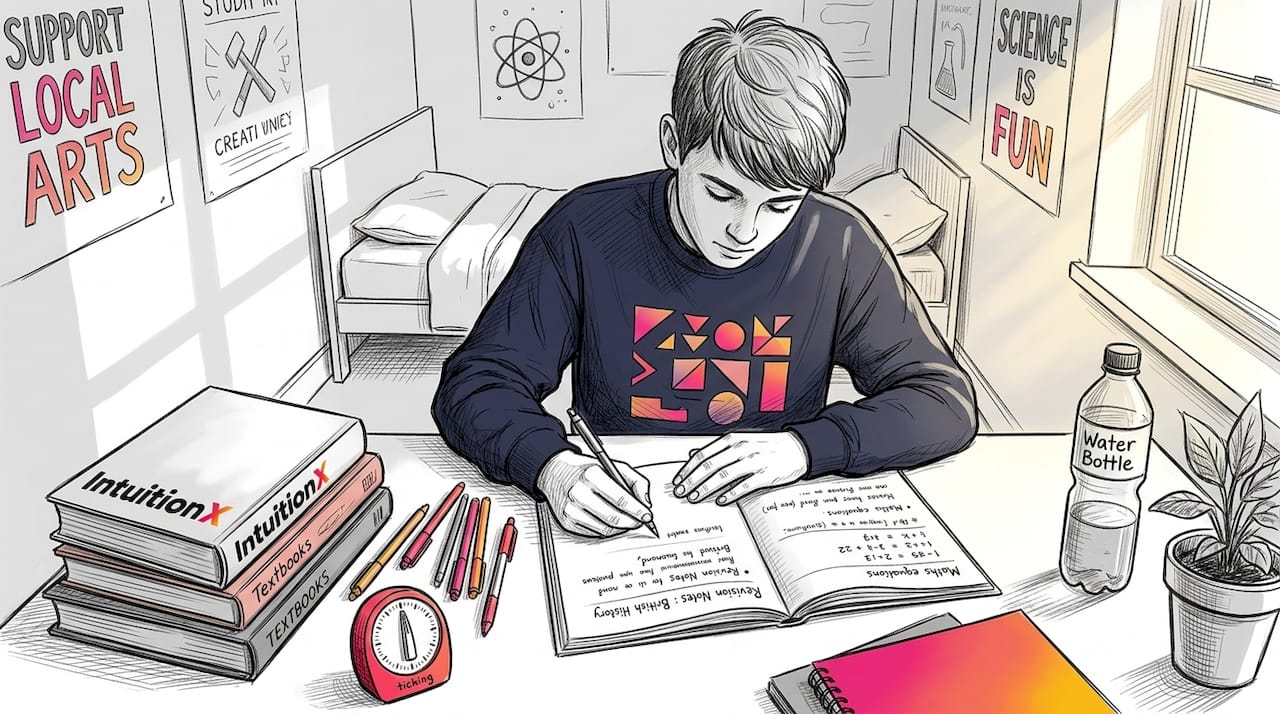
What makes it powerful is the science behind it. Sustained attention depletes after 20 to 30 minutes, so working in 25-minute intervals keeps you operating at peak focus rather than grinding through mental fatigue. The mandatory breaks are not laziness. They are recovery.
One thing most teens get wrong during breaks: they pick up their phones. Breaks with phone or social media use replace one cognitive task with another, preventing true mental rest. A break that actually works involves stepping away from screens entirely. Walk around, make a drink, stare out of the window. Your brain needs genuine disengagement to consolidate what you have just studied.
You can also adjust Pomodoro intervals based on task complexity. Some students work better on a 50/10 cycle for deep conceptual work. Others prefer the original 25/5 for memorisation-heavy sessions. Experiment and find what suits you.
3. Spaced repetition: studying smarter over time
Spaced repetition is one of the most well-evidenced methods in memory science, yet most students never use it deliberately. The idea is straightforward. Instead of reviewing material once and moving on, you revisit it at increasing intervals over days and weeks.
Reviewing content at optimised intervals targets the moment just before you would forget something. That perfectly timed review pushes the forgetting point further into the future each time. Apps like Anki automate this scheduling using an algorithm, which means you spend more time on the things you are actually forgetting and less time re-reviewing what you already know well.
For teens building active learning strategies into their study plans, spaced repetition works best when paired with active recall. You are not just revisiting notes. You are testing yourself on them at the right moment.
4. Atomic flashcards: one idea, one card
Flashcards get misused constantly. Students cram a paragraph onto a single card, then wonder why revision feels slow and ineffective. The Atomic Principle solves this. Each card should cover exactly one idea, one definition, or one fact.
Why does this matter? Because complex cards with multiple ideas trigger passive recognition rather than genuine retrieval. You glance at the card, feel vaguely familiar with the content, and move on thinking you know it. Single-idea cards force your brain to actively produce the answer rather than just recognise it.
Creating atomic flashcards eliminates what is sometimes called the "wall of text" problem, turning routine revision into high-yield retrieval practice. A good flashcard has a clear question on the front and a precise, single answer on the back. If you find yourself writing three sentences on the back of a card, split it into three cards.
5. The Feynman Technique: teach it to learn it
Nobel Prize-winning physicist Richard Feynman had a deceptively simple approach to understanding anything. Explain it as if you are teaching a 12-year-old. If you cannot, you do not understand it yet.
The practical method has four steps. First, pick a concept and write its name at the top of a blank page. Second, explain it in plain language as if teaching someone who has never heard of it. Third, identify the gaps where your explanation breaks down or gets vague. Fourth, return to your source material and fill those gaps.
This technique is particularly powerful for study skills for academic success in conceptual subjects. Physics, economics, and history all require deep understanding rather than surface memorisation. The Feynman Technique forces you to confront exactly where your understanding ends, which is the only honest starting point for real revision.
6. Self-generated questions: active engagement with content
Most students read their notes. Fewer turn those notes into questions. This one shift in habit can significantly change how well you retain material.
After covering a topic, write a set of questions that could appear on an exam. Then close your notes and answer them. This combines two powerful effects: the generation effect (creating your own questions deepens encoding) and retrieval practice (answering them from memory strengthens recall).
For preparation tips for exams, self-generated questions are particularly useful in the final weeks before a test. You are not just reviewing content. You are also practising the cognitive act of retrieving it under exam-like conditions, which is exactly what you will need to do when it counts.
7. Comparing the techniques: what to use and when
Different methods suit different tasks. This table gives you a clear overview of how the main techniques stack up.
| Technique | Best for | Cognitive demand | Common pitfall |
|---|---|---|---|
| Retrieval practice | All subjects | High | Skipping when it feels hard |
| Pomodoro Technique | Long study sessions | Medium | Using phones during breaks |
| Spaced repetition | Memorisation, languages, sciences | Medium | Inconsistent scheduling |
| Atomic flashcards | Vocabulary, definitions, facts | High | Cards that are too complex |
| Feynman Technique | Conceptual understanding | Very high | Skimming over gaps |
| Self-generated questions | Exam preparation | High | Not answering without notes |
The biggest mistake in using this table is treating it as a menu where you pick one option and ignore the rest. Mixing study methods across sessions increases depth of understanding and retention. A biology student might use spaced repetition and atomic flashcards for terminology, the Feynman Technique for understanding cell processes, and retrieval practice to tie it all together before an exam.
Pro Tip: If you only have 20 minutes to study, skip passive review entirely. Use retrieval practice. Even a short self-testing session produces far better retention than rereading the same material for the same amount of time.
8. Building your personalised study plan
Knowing the techniques is one thing. Putting them together into a workable weekly plan is where most students struggle. Here is a practical structure that works.
For teens:
- Identify the subjects requiring most effort and schedule those in your peak attention windows, usually mid-morning or early afternoon.
- Use the Pomodoro Technique to structure each session. Two or three Pomodoros per subject is a realistic daily target.
- End every session with a five-minute retrieval dump, writing down everything you covered from memory.
- Schedule spaced repetition reviews at the start of each new session rather than saving them for dedicated "review days."
- Use classroom worksheet resources and past exam papers as ready-made self-testing material.
For parents:
- Ask "What did you learn today?" rather than "How long did you study?" Duration is the wrong metric. Engagement is what matters.
- Avoid scheduling revision sessions back to back without breaks. Mental disengagement is part of the learning process, not a detour from it.
- Support without hovering. Teens learn to regulate their own study habits by practising self-management, not by being supervised through every session.
- If your teen is resistant, avoid pressure. Focus instead on showing them that smarter study means less time studying overall, not more.
9. Tools and resources to support effective study
Having the right tools removes friction from good habits. Here is what actually helps.
- Anki is the gold standard for spaced repetition. It is free, runs on any device, and automates the scheduling of your flashcard reviews based on how well you are performing.
- Forest or Be Focused are straightforward Pomodoro timer apps that track your focus sessions and help you stay consistent.
- Past exam papers are among the most underused teen study resources available. Every major UK exam board publishes free past papers online. Working through them under timed conditions is the closest simulation of exam day you can get.
- Peer study groups work well when structured properly. The key is keeping the session active. Quizzing each other and explaining concepts aloud is productive. Sitting together highlighting notes is not.
- Creative storytelling approaches can also support retention and critical thinking, particularly for humanities subjects where constructing arguments and narratives is core to the work.
- A study log is simple but underrated. Spending two minutes at the end of each session writing what you covered, what you are confident about, and what needs more work gives you a clear picture of progress over time.
My honest take on what actually makes the difference
I have worked with a lot of students over the years, and the pattern I keep seeing is this: the students who struggle most are usually not the least intelligent. They are the ones who have never been taught how to study. They default to what feels safe, which is rereading and highlighting, and then feel confused when their grades do not reflect the hours they put in.
The insight that shifted things for me was the idea of "desirable difficulties." The best study sessions feel uncomfortable. Your brain is working hard, getting things slightly wrong before correcting them, struggling to retrieve something before it clicks. That discomfort is not a sign you are failing. It is the sign that you are actually learning. When study feels easy and smooth, that is often when you are learning the least.
What I have also noticed is that combining Pomodoro structure with active recall changes how teens feel about studying, not just how they perform. The timed intervals give a session a beginning and an end, which reduces the dread of sitting down to work. The retrieval practice gives tangible proof of progress, which builds genuine confidence.
The best role parents can play is not to monitor or manage the process, but to have conversations about it. Ask what technique they tried. Ask what was hard. Normalise the struggle. That shift in framing, from "studying is a chore" to "studying is a skill I am developing," is often the most important change of all.
— Angus
How Intuitionx can take your study further
If these techniques have sparked your curiosity about how to study efficiently, Intuitionx takes them to the next level. Our AI tutor, Omniscience, is built on Oxbridge-pedigree pedagogy and actively uses Socratic questioning to push your thinking rather than just hand you answers.

Think of it as having a 24/7 thinking partner who will challenge you, guide you through your gaps, and adapt to exactly where you are in your learning. For teens serious about improving their learning workflow, Intuitionx is built to support the kind of active, effortful learning that the best study methods demand. No passive reviewing. No essay writing for you. Genuine learning, every session. Try Intuitionx at app.intuitionx.ai and find out what studying like the top 1% actually feels like.
FAQ
What are the best study methods for teens?
Retrieval practice, spaced repetition, and the Pomodoro Technique are consistently the most effective. They require active engagement rather than passive review, which is what builds durable memory.
How do I study efficiently for exams?
Use active recall to test yourself after each session, space your review over days rather than cramming, and practise under timed conditions using past exam papers. Each of these approaches directly targets the cognitive processes needed for exam performance.
Why does rereading not help me remember things?
Rereading creates familiarity, not recall. When you reread, your brain recognises the material as familiar, which feels like learning but is not. Active retrieval forces your brain to produce information, which is the only route to reliable memory.
How long should a teen study each day?
Quality matters more than quantity. Two to three focused Pomodoro sessions of 25 minutes each, with genuine breaks between them, typically outperforms two hours of passive, unfocused revision. Adjust based on workload and upcoming exam pressure.
Can parents help with study techniques for teens?
Absolutely. The most useful thing a parent can do is ask questions about what their teen learned rather than how long they studied. Encouraging teens to explain topics aloud to you is also an excellent application of the Feynman Technique in a low-pressure setting.