

TL;DR:
- Effective study habits rely on active retrieval, spaced repetition, and consistent routines rather than motivation. Building habits through micro-habits, habit stacking, and identity shifts ensures long-term adherence and improved retention. Visual trackers and environment design reinforce discipline, making study an automatic part of daily life.
Effective study habits are defined as consistent, active learning routines that force retrieval, deepen understanding, and build long-term retention. Students using active learning methods scored 11.1% to 16.6% higher on exams compared to peers who relied on passive rereading. That gap is not talent. It is method. Knowing how to create effective study habits means choosing the right techniques, building routines that stick, and managing your time with intention. This guide covers all three, with science-backed strategies you can start using today.
How to create effective study habits: the core techniques
The most effective study techniques are active recall and spaced repetition, a finding confirmed by Dunlosky et al.'s landmark 2013 review and validated again in 2026 research. These two methods consistently outperform passive approaches like rereading and highlighting. Understanding why they work is what separates students who improve from those who stay stuck.
Active recall means testing yourself on material before you feel ready. Instead of reading your notes again, close them and write down everything you remember. This forces your brain to retrieve information, which strengthens the memory trace far more than recognition alone. Self-quizzing, flashcards, and practice tests all count.
Spaced repetition means spreading your study sessions across days and weeks rather than cramming everything into one sitting. Reviewing material at increasing intervals exploits the spacing effect, a well-documented principle in memory science. Apps like Anki are built around this principle and make scheduling automatic.
Beyond these two pillars, the following techniques round out a strong study toolkit:
- Interleaving subjects: Mixing topics within a session (maths, then history, then biology) rather than blocking one subject at a time improves long-term retention and problem-solving flexibility.
- Summarising in your own words: Restating concepts without looking at your notes forces deeper processing than copying. This is sometimes called the Feynman Technique, named after physicist Richard Feynman.
- Generating practice questions: Writing your own exam questions about the material you have just studied is one of the highest-utility activities a student can do.
- Elaborative interrogation: Asking "why is this true?" about each fact you learn connects new knowledge to existing understanding, making it far stickier.
Pro Tip: After every study session, spend five minutes writing down the three most important things you just covered without looking at your notes. This single habit activates active recall and consolidates memory before you even leave your desk.
How to build study habits that actually stick
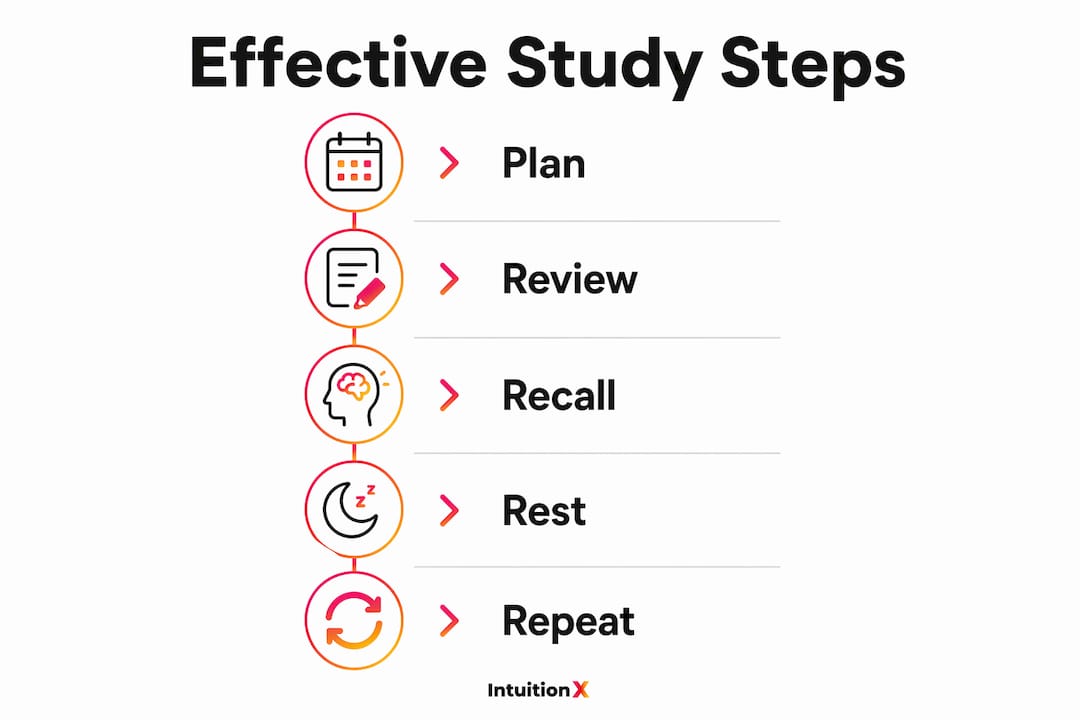
Building a study habit is not about willpower. Success is built on systems, not motivation alone. The most reliable framework for habit formation is the Cue-Routine-Reward Loop, a model popularised by Charles Duhigg in The Power of Habit. A cue triggers the behaviour, the routine is the behaviour itself, and the reward reinforces it. For studying, your cue might be sitting at your desk at 6pm, your routine is a 45-minute active recall session, and your reward is 20 minutes of guilt-free screen time.
The 2-minute rule and micro-habits
The biggest barrier to studying is starting. Micro-habits using the 2-minute rule drastically improve habit formation speed by making the entry point so small it is impossible to fail. Instead of committing to two hours of revision, commit to opening your notes for two minutes. Once you start, momentum takes over. The goal is to make the habit automatic before you scale it up.
Habit stacking
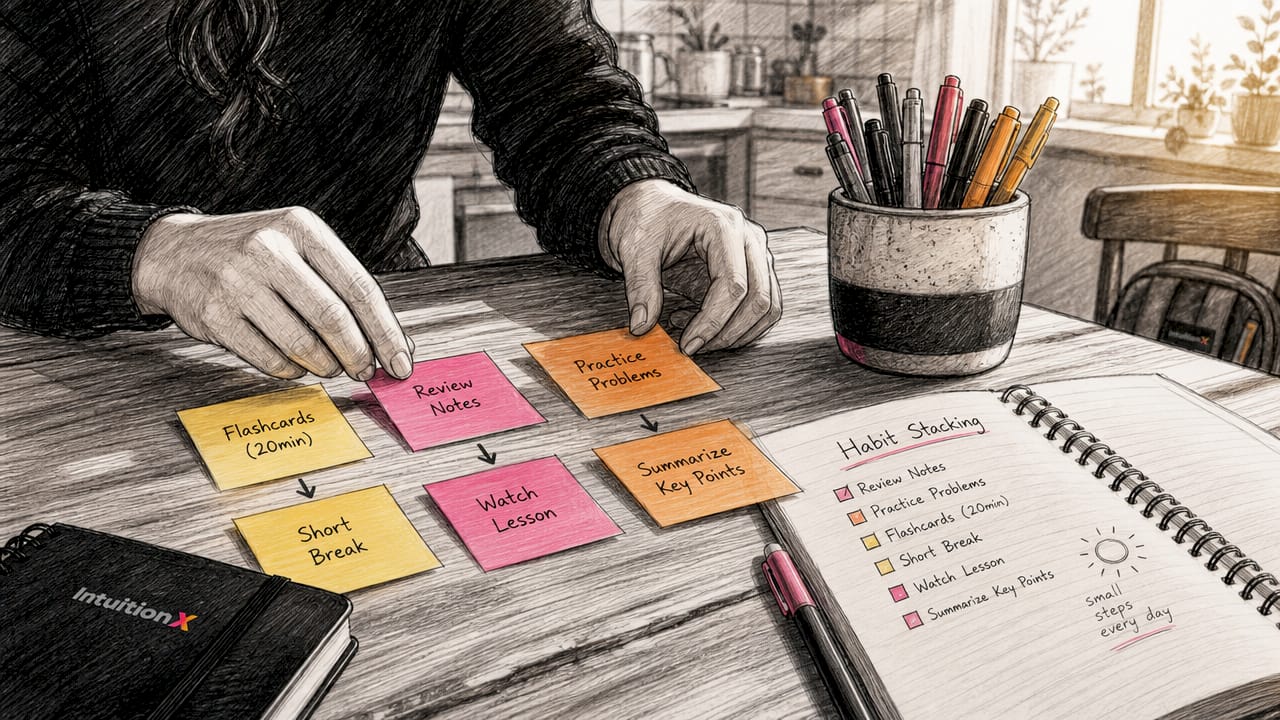
Habit stacking chains new study behaviours onto existing ones, creating a routine that quickly becomes automatic. The formula is simple: "After I do X, I will do Y." After you make your morning coffee, you review five flashcards. After dinner, you spend ten minutes summarising the day's lessons. Anchoring study to habits you already have removes the need to decide when to start.
Implementation intentions
Implementation intentions reduce decision fatigue and improve study adherence by pre-planning responses to common obstacles. Write down your If-Then plan before the week starts. "If I feel too tired to study after school, then I will do ten minutes of flashcard review instead of a full session." This pre-empts the most common excuses before they derail you.
Tracking and environment design
| Strategy | How it helps |
|---|---|
| Visual habit tracker | Seeing a chain of completed days creates a psychological reward that reinforces the behaviour |
| Dedicated study space | A fixed location trains your brain to associate that space with focus |
| Phone in another room | Removing the device eliminates the most common source of distraction |
| Prepared materials | Laying out notes and books the night before removes friction at the start of each session |
Habit trackers improve success rates by two to four times due to visual progress and reward. That is a significant multiplier for something as simple as ticking a box on a calendar or using a bullet journal.
Pro Tip: Design your study environment the night before. Put your textbook open on your desk, close unnecessary browser tabs, and set a timer. Reducing the number of decisions you need to make before starting is one of the fastest ways to build consistency.
What are the practical steps to build a study routine?
A study routine is built gradually, not installed overnight. Follow this sequence to go from zero to consistent without burning out.
- Start absurdly small. Commit to one page of reading or two minutes of flashcard review. The goal in week one is not learning. It is showing up.
- Fix your study times. Schedule sessions at the same time each day. Consistency in timing builds the habit faster than varying when you study.
- Use active methods from day one. Even in short sessions, practise active recall rather than passive reading. Quality matters more than quantity at this stage.
- Increase gradually. Add five to ten minutes per week once the habit feels automatic. Scaling too fast is the most common reason students quit.
- Take structured breaks. Human focus declines after 40 to 60 minutes, so plan a short break after each session block. A ten-minute walk or rest restores cognitive function and prepares you for the next round.
- Reset without guilt after a slip. Missing one session is not failure. The rule is simple: never miss twice. Punishing yourself for a single missed day is more damaging to the habit than the missed day itself.
Here is what a realistic first week might look like:
- Monday: 10 minutes of active recall on today's lesson notes
- Wednesday: 15 minutes of flashcard review using Anki
- Friday: 20 minutes of summarising the week's key concepts in your own words
- Weekend: One practice question per subject studied this week
This is not a heavy schedule. That is the point. You are building the study routine first. The volume comes later.
Pro Tip: Treat your study sessions like appointments in your calendar. Give them a specific time, a specific subject, and a specific method. Vague intentions like "I'll study tonight" almost never happen. Specific plans almost always do.
How to troubleshoot common challenges and stay motivated
Motivation is unreliable. Every student feels it at the start of term and loses it by week three. The fix is not to chase motivation but to build an identity around studying. Identity-based habits outperform outcome-based ones for consistent study behaviour. Stop telling yourself "I need to get an A" and start telling yourself "I am someone who studies every day." The shift sounds small. The effect is not.
Here are the most common obstacles students face and how to handle each one:
- Fatigue: Use your If-Then plan. Ten minutes of low-effort review is better than nothing and keeps the habit alive.
- Distraction: Put your phone in a different room. Use apps like Forest or Freedom to block distracting sites during sessions.
- Feeling behind: Do not double up on sessions to compensate. One normal session is enough. Doubling up creates pressure that leads to avoidance.
- Illusion of competence: Forced retrieval outperforms repeated reading by exposing what you do not actually know. If you feel like you understand something, close your notes and explain it aloud. If you cannot, you did not know it as well as you thought.
- Poor sleep: Sleep is not optional for learning. Memory consolidation happens during sleep, and structured study breaks restore focus during the day. Prioritising seven to nine hours is one of the highest-return study decisions you can make.
"Building an identity as 'a student who studies daily' maintains consistency better than any outcome-focused goal. Systems and habits, not motivation, are what carry you through."
The students who succeed long-term are not the ones who feel most motivated. They are the ones who have made studying so automatic that it requires almost no mental effort to begin. That is the goal. Habit over hustle, every time.
Key takeaways
Effective study habits are built on active retrieval, spaced practice, and consistent routines, not motivation or marathon sessions.
| Point | Details |
|---|---|
| Active recall beats rereading | Self-quizzing and practice tests produce 11.1% to 16.6% higher exam scores than passive study. |
| Start with micro-habits | The 2-minute rule makes starting frictionless and builds consistency before scaling up. |
| Use habit stacking | Anchor study sessions to existing daily behaviours to make them automatic faster. |
| Track your progress visually | Habit trackers improve success rates by two to four times through visual reward. |
| Shift your identity | Thinking of yourself as "someone who studies daily" sustains habits when motivation fades. |
Why I think most students are solving the wrong problem
Students almost always come to me convinced their problem is time. They do not have enough of it. But when we look at how they actually spend their study hours, the issue is rarely time. It is method and identity.
I have seen students spend three hours rereading the same chapter and feel productive because they were at their desk. That feeling is the illusion of competence in action. Rereading is comfortable. Active recall is uncomfortable. And the uncomfortable method is the one that works.
The other thing I have noticed is that students set goals that are far too large for where they are right now. "I am going to study for two hours every evening" is not a habit plan. It is a wish. The students who actually build lasting study habits are the ones who start with something almost embarrassingly small and protect that small habit fiercely until it becomes automatic.
The mindset shift that changes everything is moving from "I need to study more" to "I am the kind of person who studies every day." Once that identity takes hold, the behaviour follows. You stop negotiating with yourself each evening about whether to open your books. You just do it, because that is who you are.
Start small. Be consistent. Trust the process. The results will follow.
— Angus
How Intuitionx can support your study habits
Building strong study habits is the foundation. Having the right thinking partner alongside you is what accelerates progress.

Intuitionx is a 24/7 AI tutor built on Oxbridge-level pedagogy and memory science. It uses Socratic questioning to push your thinking rather than just giving you answers, which means every session with Intuitionx is active recall in practice. Whether you are a GCSE student building your first revision routine or a university student preparing for finals, Intuitionx adapts to your level and keeps you genuinely engaged. Sir Anthony Seldon, described by the BBC as "one of Britain's leading educationalists," backs the platform. Start learning with Intuitionx today and put your new study habits to work.
FAQ
What are effective study habits?
Effective study habits are consistent, active learning routines that use techniques like active recall, spaced repetition, and self-testing to build long-term retention. They differ from passive approaches like rereading because they force the brain to retrieve and process information rather than simply recognise it.
How long should a study session be?
Research shows human focus declines after 40 to 60 minutes, so study sessions of 45 minutes followed by a short break are optimal. Shorter sessions using active methods are more productive than long passive ones.
How do I stop losing motivation to study?
Replace motivation with identity. Telling yourself "I am someone who studies daily" sustains the behaviour far longer than outcome-based goals like grades or exam results. Pair this with a visual habit tracker to reinforce consistency through small daily wins.
What is the best study technique for remembering information?
Active recall and spaced repetition are the highest-utility techniques confirmed by research, including Dunlosky et al.'s review and 2026 findings. Self-quizzing, practice tests, and Anki-style flashcard review are the most practical ways to apply both methods.
How do I build a study habit from scratch?
Start with the 2-minute rule: commit to just two minutes of studying at a fixed time each day. Once the habit is automatic, increase the session length gradually. Habit stacking, anchoring study to an existing behaviour like making tea or finishing dinner, speeds up the process significantly.