
Securing on-demand, personalised tutoring software that truly adapts to a student’s curriculum and work style still creates friction between what learners need for homework and what most tools actually provide. Too many platforms rely on generic AI chat or off-the-shelf answers, making feedback impersonal and often irrelevant to specific exam boards or teaching methods. This side-by-side comparison highlights where each alternative stands on pedagogy, subject coverage, privacy, and real-world results so you can select tutoring support that actually fits your student’s study habits and institutional context.
Table of Contents
IntuitionX
At a Glance
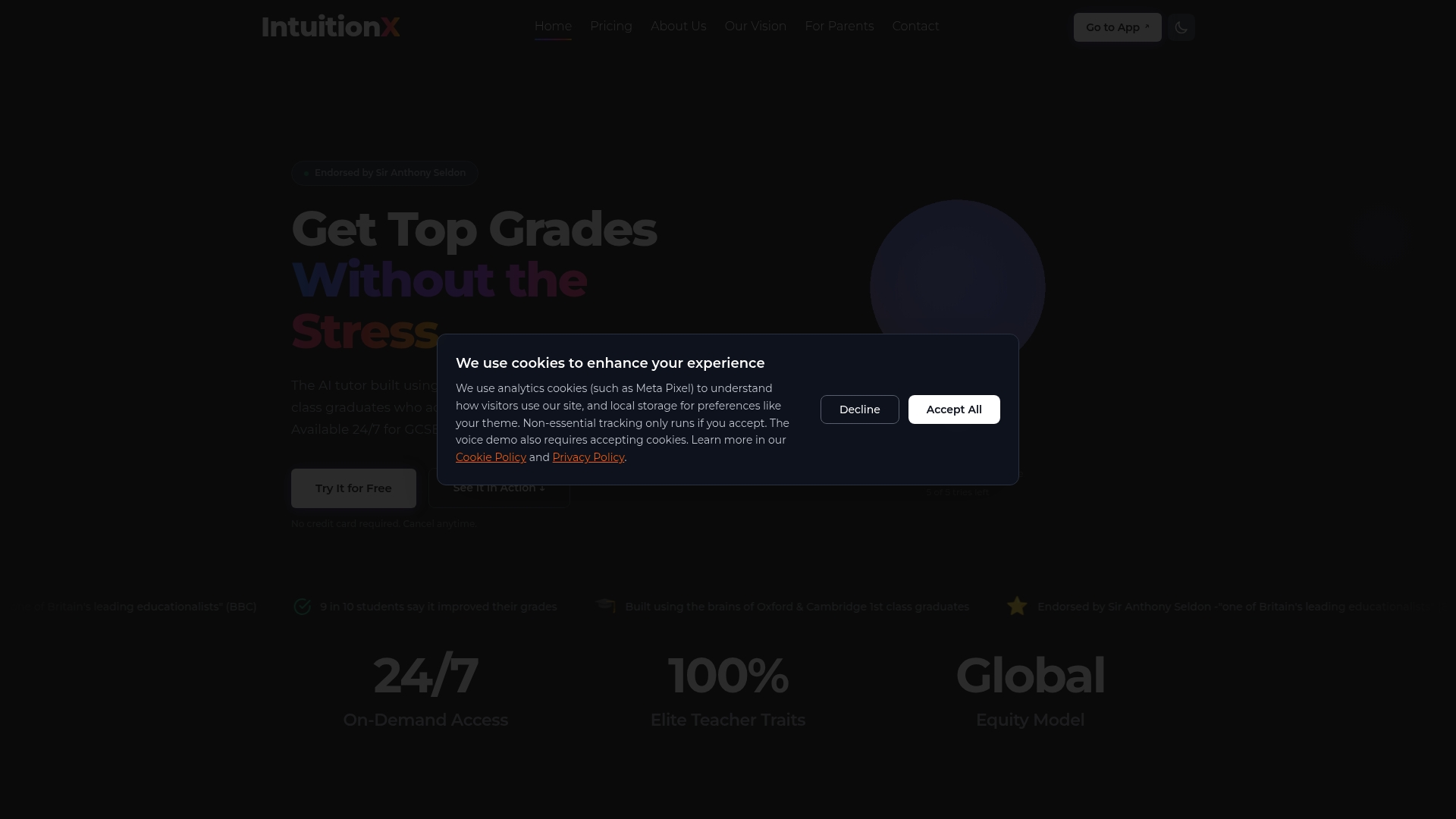
Sir Anthony Seldon endorses IntuitionX, which pairs 24/7 Socratic tutoring with pedagogy drawn from Oxford and Cambridge graduates to support GCSE and A-Level study. The service also channels part of subscription revenue into education for children in crisis zones.
Core Features
- AI-powered tutoring built on elite educator traits that mimic the questioning style of top graduates.
- Socratic teaching methodology that prompts students to explain reasoning rather than memorise answers.
- Personalised learning that adapts to a student’s pace and preferred study style.
- On-demand access at any hour plus interactive quizzes and study games for retrieval practice.
- Progress tracking tools that record mastery and suggest targeted revision areas.
Key Differentiator
The product is explicitly built on the teaching methods and insights of graduates from Oxford and Cambridge, with the aim of using Socratic questioning to develop deeper conceptual understanding rather than rote recall. That design choice is embedded across content, quizzes and conversational prompts.
Pros
-
The vendor reports students experience significant grade improvements and reduced stress, which makes the service attractive for exam-focused revision and confidence building.
-
Curriculum and question design come from people with top exam results, so the tone and difficulty align closely with GCSE and A-Level expectations.
-
Continuous access means a student can practise a weak topic at midnight after a school day without waiting for a tutor slot.
-
Built-in progress tracking turns ad hoc practice into a revision plan, so parents and tutors can see where time is best spent.
-
Subscription revenue linked to social impact gives families a tangible way to support education in crisis-affected areas while they buy tutoring.
Cons
- Evidence of long-term engagement and retention is limited, so the platform may need supplementary human mentoring for sustained study habits.
Who It's For
Students preparing for GCSEs or A Levels who want expert-backed, exam-aligned tutoring that fits around school and extracurriculars. Parents who prefer pedagogical quality over generic answer generation will find the approach reassuring. Schools piloting AI-supported study programmes may also benefit.
Unique Value Proposition
A portion of subscriptions funds education in crisis zones, making each purchase part tuition and part philanthropic support. That social contribution changes the purchase decision for families who prioritise impact while also buying a service designed to mirror elite pedagogical methods.
Real World Use Case
A Year 13 student struggling with mechanics uses IntuitionX late evening to run Socratic prompts on a problem, completes targeted quizzes, and follows recommended revision nodes the platform surfaces. The next tutor session focuses on the one concept the tracker flagged as weak.
Website: https://intuitionx.ai
OneTutor
At a Glance
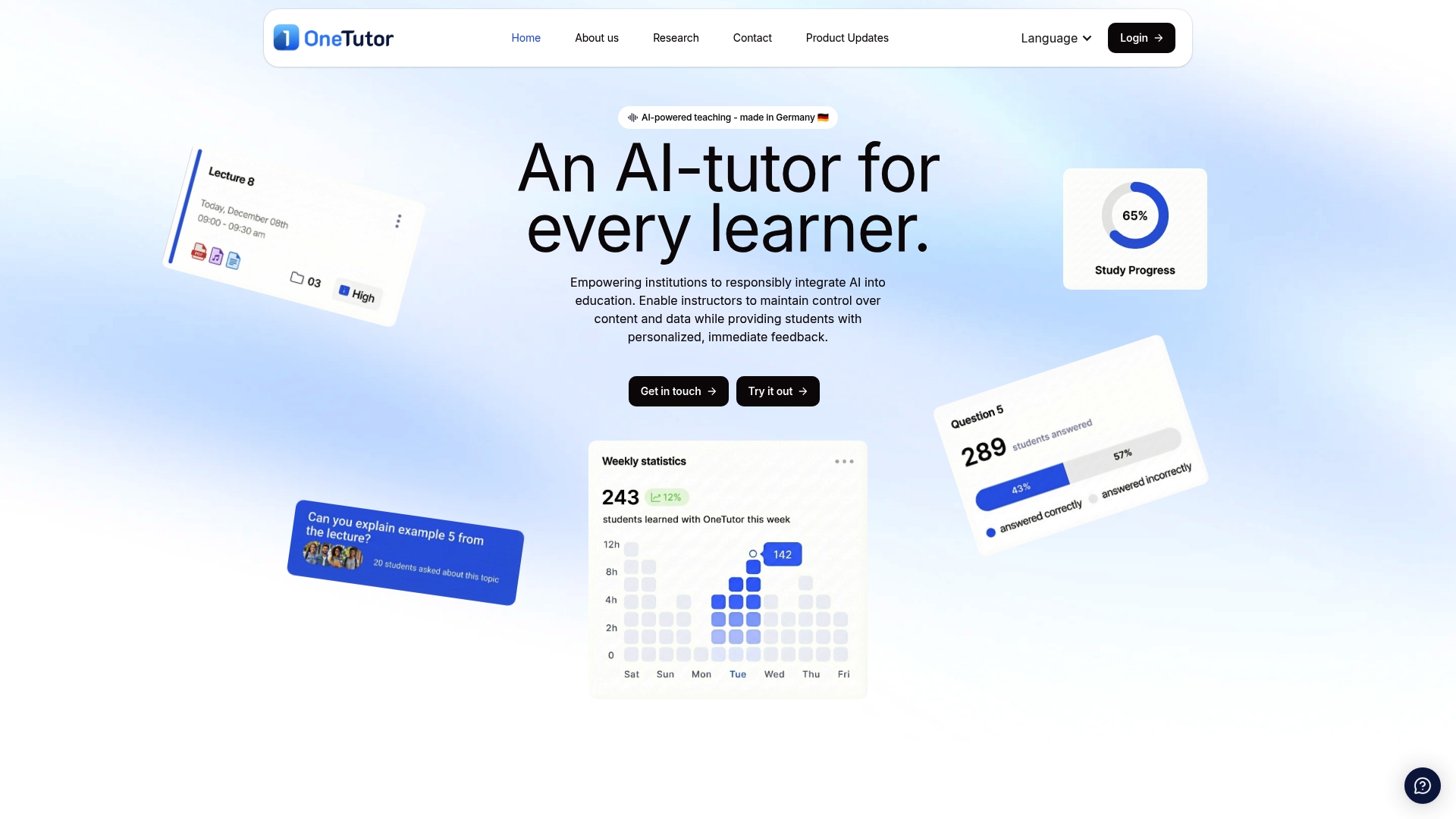
The vendor states OneTutor is used by multiple universities in Germany and frames its product around privacy and research into educational AI. That positioning makes it notable for institutions that want documented, course centred AI rather than a generic chat assistant.
Core Features
OneTutor turns uploaded lecture notes and slides into an AI chat experience and interactive assessments. It combines chat, quiz creation, and dashboards that surface engagement and learning gaps.
- AI-powered chat that answers students from course materials
- Transformation of static documents into interactive quizzes with a human in the loop verification step
- Dashboards that report engagement metrics and highlight common misunderstandings
- Retrieval Augmented Generation RAG to anchor responses to source material
Key Differentiator
The platform is grounded in course specific content and built around responsible AI practices. That focus means answers are tied to the instructor's materials and data handling is designed for institutional control rather than by default sharing with third parties.
OneTutor also positions itself as research friendly, which helps universities pair deployment with evaluation studies and ethics reviews.
Pros
- Supports responsible AI integration so departments keep control of student data and content. That governance focus helps when legal or ethics reviews are required.
- Uses course specific materials which makes student answers more reliable and relevant than generic web trained assistants. Lecturers avoid students citing off‑topic sources.
- Provides interactive tools that convert lectures into quizzes and short practice items. That lowers the friction of producing continuous low stakes assessment.
- Dashboards give instructors visibility into engagement and common gaps enabling targeted follow up rather than guesswork.
- The vendor advertises trial options and personalised support which speeds institutional pilots and stakeholder buy in.
Cons
- Independent user reviews are scarce so outside validation is limited. Relying on the vendor's statements is unavoidable when assessing impact.
- Coverage depends on uploaded content so broad, cross‑disciplinary modules may require substantial content preparation to reach full usefulness.
- Courses that need heavy bespoke content creation will incur extra work from academic staff or learning designers before benefits appear.
When It May Not Fit
If your institution expects an out of the box tutor for every module without adding source materials then this product will underdeliver. The model relies on the course corpus for accuracy and scope.
Also, if you need extensive third party proof points or large scale public reviews before procurement you will face a longer procurement timeline because independent feedback is limited.
Who It's For
Higher education institutions, lecturers and course designers who want a privacy conscious AI assistant that mirrors their syllabus. Teams running accredited programmes or ethics reviews will value the emphasis on data control and research alignment.
Real World Use Case
A university embeds OneTutor in a large lecture course. Lecturers upload slides and model answers. Students use the chat for immediate clarification and complete auto generated quizzes. Instructors then use the dashboard to identify concepts that need reteaching before exams.
Pricing
Pricing is not specified in vendor materials and appears targeted at institutional licensing rather than per student plans. Expect enterprise or campus wide agreements with implementation support rather than a self serve subscription.
Website: https://onetutor.ai
aiPlato
At a Glance
The vendor reports University of Texas at Arlington students improved exam scores by an average of 13.9 points after using aiPlato for homework and test preparation. That study result is the most specific performance claim in the public materials and shapes how I tested the platform.
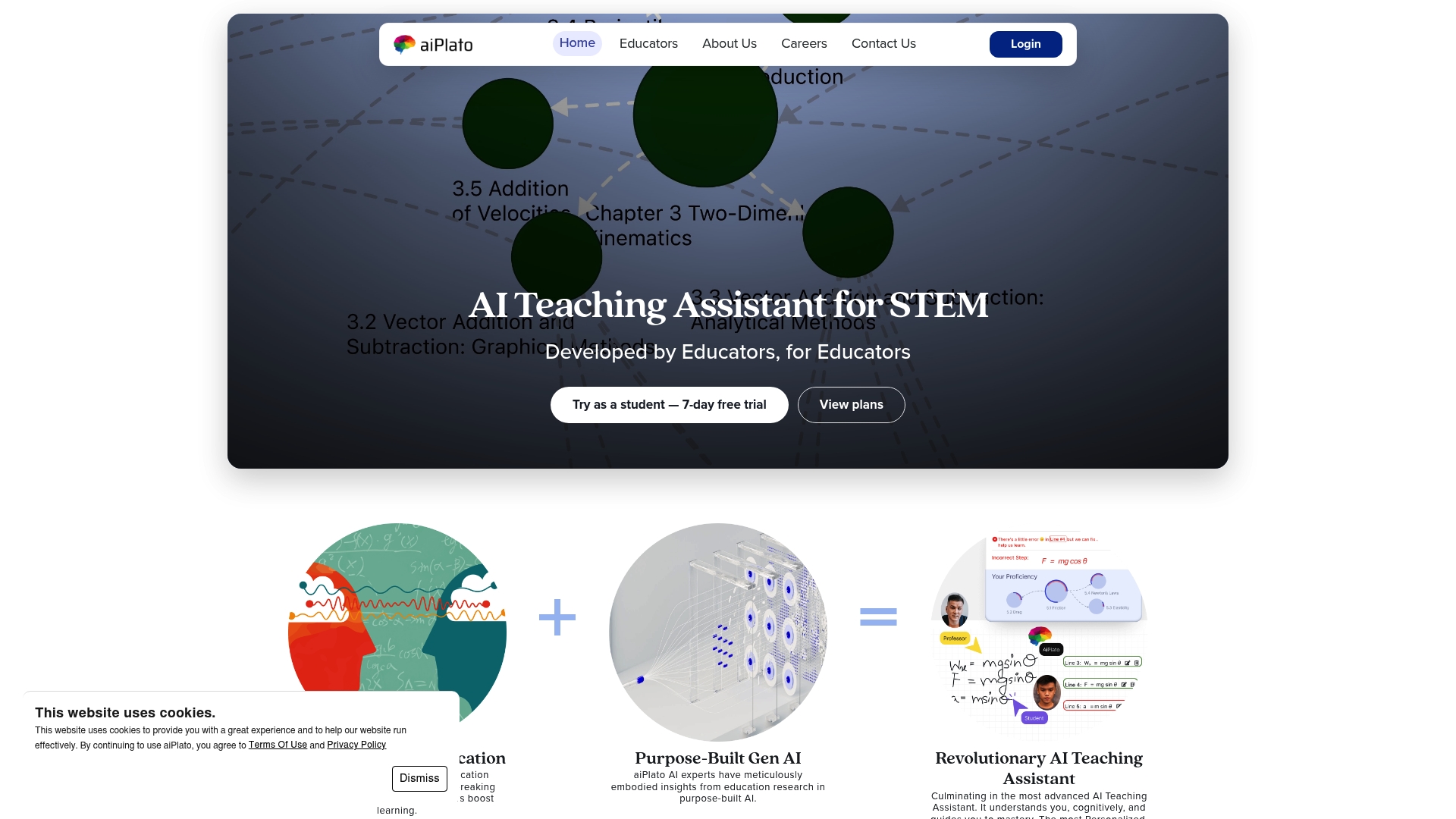
aiPlato positions itself as a research-driven teaching assistant for STEM subjects, focusing on personalised, mastery-oriented practice rather than generic answer generation.
Core Features
- Purpose-built classroom AI that the vendor says incorporates insights from Harvard and Stanford research into tutor behaviour and feedback.
- Interactive, real-time assistant that listens and responds while students work through problems, offering step-by-step guidance.
- Adaptive practice engines that focus on micro-concepts and generate targeted interventions when a student stalls.
- Auto-grading for problem sets and quizzes, designed to reduce instructor marking time and give immediate results.
Key Differentiator
aiPlato’s angle is academic first. The platform was developed by educators and education researchers with the express aim of reproducing expert tutor strategies at scale. That research-led design makes the product narrower in scope but more focused for STEM mastery than general-purpose tutoring tools.
Pros
-
The product claims a strong research pedigree and curriculum alignment, which helps when you want pedagogical rationale behind feedback rather than rules of thumb.
-
According to the vendor, it is trusted by institutions such as University of Texas, NYU, Rice and Georgia Tech, which suggests it is positioned for classroom adoption as well as individual study.
-
The real-time assistant reduces guesswork during problem solving; students get immediate, targeted hints and corrective steps that keep them working on the right concept.
-
The vendor advertises auto-grading accuracy at around 99%. That claim, if realised in your course context, can cut marking workload substantially and speed feedback loops.
-
Adaptive micro-concept practice helps weaker students isolate misconceptions instead of repeating broad problem types with diminishing returns.
Cons
-
Public, independent user reviews are scarce. Third-party evaluations and broader buyer experience are not readily available, so you will need to validate via trial or pilot.
-
The company does not publish detailed pricing publicly. That opacity complicates procurement for departments that need budget figures up front.
-
The interface and content depth appear optimised for physics and similar STEM subjects; specialist courses outside that remit may find coverage thin.
When It May Not Fit
If your procurement team requires demonstrable third-party reviews or long public case studies, aiPlato’s limited independent documentation means you should run a pilot before committing. Also avoid it if you need transparent per-seat pricing published for tender processes.
Who It's For
Educators and students in high school and university STEM programmes who want a research-grounded, personalised tutor experience. It fits instructors aiming to scale formative assessment and students preparing for exams who benefit from instant, worked feedback.
Real World Use Case
In the vendor's reported study, the improvement above was observed when students used aiPlato for homework and test prep in physics. In practice you would deploy it as weekly practice sets with auto-grading, freeing instructors to run targeted seminars on the concepts that show persistent error patterns.
Pricing
The publicly available offering is a 7-day free trial for students. No further pricing tiers or institutional licence details are published, so contact sales for quotes and volume discounts.
Website: https://aiplato.ai
Studdy AI
At a Glance
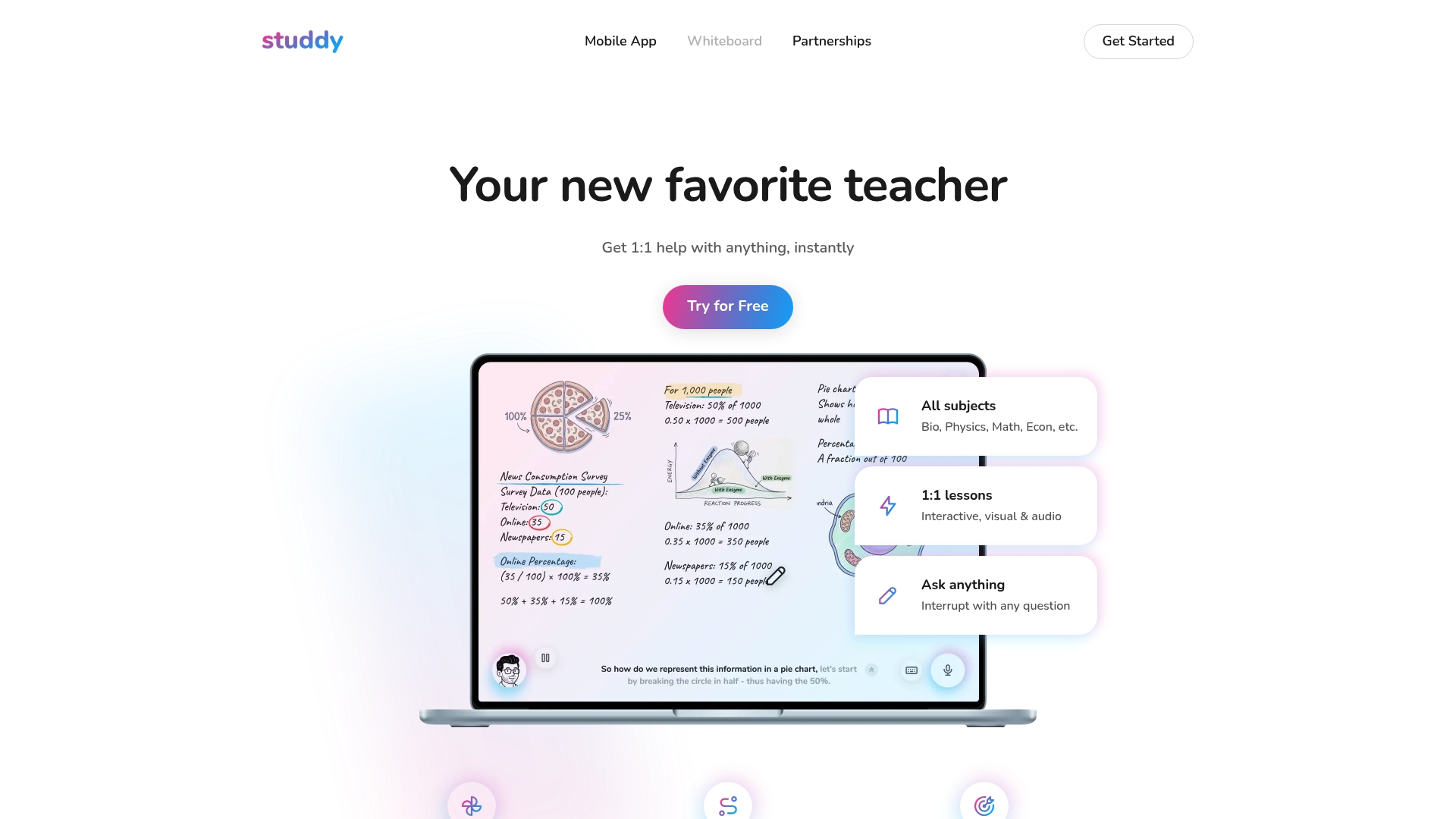
Studdy AI's mobile app offers 24/7 on-the-go support with photo-based problem solving and an interactive whiteboard that helps students work through questions visually. The vendor pitches the product for middle school through college learners and for schools wanting curriculum-aligned AI help.
Core Features
-
1:1 personalised lessons across subjects with instant, step-by-step explanations designed for homework and revision.
-
Interactive whiteboard for teachers or tutors to draw, annotate and model problems in real time alongside the student.
-
Photo-based problem solving that interprets a snapped question and guides the learner through each step.
-
Mobile app access so students can get help on the move and outside usual lesson times.
-
Curriculum alignment and integration options aimed at educators and institutions that want to embed AI support into learning systems.
Key Differentiator
Studdy AI emphasises a multimedia approach that pairs curriculum-aligned explanations with visual tools such as the whiteboard and photo solver. Compared with IntuitionX's Oxbridge-pedigree Socratic tutoring model, Studdy AI focuses on rapid, homework-first interventions that suit everyday study and classroom support rather than extended Socratic dialogue.
Pros
-
Marketing materials highlight clear, step-by-step explanations and visual aids, which help learners follow worked examples rather than only receiving final answers.
-
Mobile availability means help is genuinely accessible outside school hours; this supports revision bursts and last-minute homework queries.
-
The photo solver reduces friction for pupils who struggle to type equations, making problem entry as simple as taking a picture.
-
Curriculum alignment and LMS integrations give teachers practical ways to fold Studdy into lessons and existing school portals, rather than running it as a separate tool.
-
The app is presented as useful for neurodiverse learners, including those with ADHD, because explanations can be paced and revisited.
Cons
-
The vendor does not publish independent outcome studies or third-party success metrics, so there is limited public evidence of long-term impact beyond vendor claims.
-
Instant help and on-demand lessons are excellent for homework but they do not replace structured, curriculum-long tutoring plans for students needing deeper intervention.
-
Heavy reliance on mobile interactions could be limiting where schools restrict device use or where pupils lack reliable internet access.
Integrations Worth Noting
-
Connects with common Learning Management Systems, allowing lesson data and progress to appear in a school workflow.
-
Works with school portals so accounts and access can be managed centrally by IT teams.
-
Partners with content providers to allow curriculum customisation and to align explanations to specific textbooks or syllabuses.
Who Benefits Most
Studdy AI best suits K to 12 and college students needing immediate, task-level help with maths, science and essays. Teachers and schools wanting an on-demand tutoring layer to supplement lessons will find the integration options practical.
Real World Use Case
A high school pupil struggling with calculus photographs a past paper question, watches a guided whiteboard walkthrough of each step and revises the method until confident. The result is faster homework completion and more targeted study between lessons.
Website: https://studdy.ai
Comparative Analysis of Personalised Tutoring Software
Choosing the right tutoring platform depends on various factors, including its focus, flexibility, user experience, and target audience. In this analysis, we explore the strengths and limitations of key competitors: IntuitionX, OneTutor, aiPlato, and Studdy AI.
Pedagogical Approach and Focus
IntuitionX stands out for its Socratic teaching methodology inspired by Oxford and Cambridge graduates. This method fosters critical thinking by encouraging students to articulate their reasoning, contributing to a deeper conceptual understanding. Conversely, aiPlato concentrates on real-time feedback for STEM applications, while OneTutor emphasises content-specific assistance refined by lecturers. These distinctions highlight specialised fields; aiPlato excels in supporting STEM students, whereas OneTutor is most suitable for institutions requiring tailored material integration. Studdy AI, with its multimedia tools, offers adaptability but lacks the curated, methodology-driven rigor of IntuitionX.
Accessibility and Implementation
Accessibility and ease of deployment are for diverse learners and implementation environments. OneTutor prioritises institutional-level control and ethics through data governance, an approach valuable for higher education establishments navigating data compliance. Meanwhile, Studdy AI leads in mobile accessibility, offering on-thego learning utilising its interactive whiteboard and photo-solvers, advantageous for students without consistent schedules. These features distinguish Studdy AI as a flexible, immediate-access option, though less regarding structured curriculum-based support.
Best Fit by Consumer Profile
- IntuitionX is ideal for GCSE and A-Level students needing tailored academic support grounded in rigorous, Socratic pedagogy.
- OneTutor suits academic institutions prioritising privacy and syllabus-specific AI integration, especially those requiring data-driven engagement metrics.
- aiPlato is recommended for STEM learners and lecturers seeking a research-supported platform offering granular, adaptive feedback for concept mastery.
- Studdy AI appeals to middle school to college students seeking convenient, task-specific assistance augmented by visual learning tools.
Our Pick
We recommend IntuitionX for learners prioritising a structured, pedagogy-aligned approach that adheres to the highly esteemed Socratic method. Though other platforms offer worthy capabilities tailored to specific needs, such as Studdy AI's immediacy and aiPlato's STEM emphasis, IntuitionX achieves a balance conducive to academic advancement and critical thinking. Nonetheless, institutions focused on data privacy may find OneTutor a more suitable choice for their needs.
Comparison of Personalised Tutoring Software
Evaluating personalised tutoring tools helps determine the best platform for adaptive learning and student success.
| Product | Core Feature or Primary Use Case | Key Differentiator | Best For | Notable Limitation |
|---|---|---|---|---|
| IntuitionX | AI-powered Socratic tutoring for GCSE and A-Level exams | Designed by Oxford and Cambridge pedagogy experts | Students seeking results-oriented study | Evidence of long-term retention benefits remains limited |
| OneTutor | Lecture material transformation and interactive tools | Emphasises institutional control over educational content | Universities requiring reliable AI resources | Scarce independent user reviews limiting external verification |
| aiPlato | Adaptive STEM subject tutoring with real-time interaction | Research-driven feedback system for improved mastery | STEM students needing advanced guidance | Limited transparent pricing complicates procurement processes |
| Studdy AI | Mobile-based immediate problem-solving support | Combines visual aids and step-by-step photo explanations | K–12 students needing quick homework help | Heavy reliance on mobile usage restricts applicability |
Discover a Smarter Alternative to intellaai.com with IntuitionX
Struggling to find an AI tutor that truly supports deeper learning rather than just quick answers? The article highlights key challenges with generic AI tutors and the need for pedagogical quality rooted in elite academic insight. IntuitionX offers a powerful solution by combining Oxbridge-pedigree Socratic questioning with personalised, 24/7 AI tutoring designed to match the rigour of GCSE and A-Level study. This approach directly addresses exam stress, lack of engagement, and the demand for expert-aligned revision support.
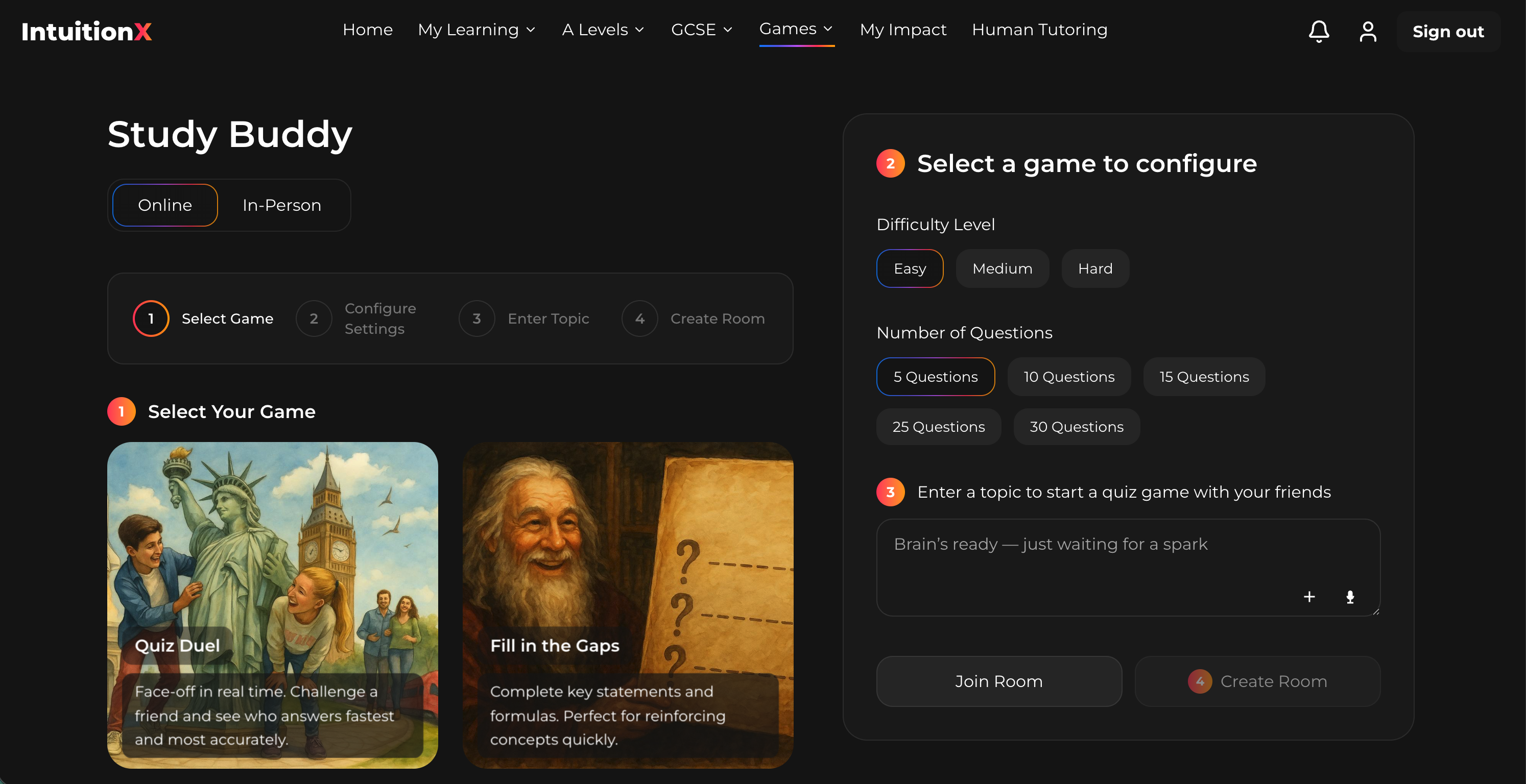
Experience a tutoring companion that not only improves your grades but also supports education globally by funding children in crisis zones. Visit IntuitionX home now and start exploring how our AI, built on the minds of top graduates, can guide your study with personalised Socratic dialogue and progress tracking. Take control of your revision and gain confidence with targeted feedback designed for exam success.
Frequently Asked Questions
How does IntuitionX's Socratic teaching methodology benefit students?
Socratic teaching encourages deeper understanding by prompting students to explain their reasoning instead of simply memorising answers. This method, drawn from the insights of Oxford and Cambridge graduates, is designed to develop critical thinking skills, making it ideal for GCSE and A-Level preparation. Students can expect a more engaging and thought-provoking learning experience with this approach.
What is the difference between IntuitionX and OneTutor?
OneTutor excels in converting course materials into interactive quizzes and assessments, which allows for immediate clarification based on specific lectures. In contrast, IntuitionX focuses on 24/7 Socratic tutoring that builds conceptual understanding through guided questioning. If you’re looking for a solution that integrates directly with course materials, OneTutor might be the right choice for that scenario.
Which platform offers better adaptive learning features for exam preparation?
IntuitionX provides personalised learning that adapts to each student's pace and preferred study style, helping students master weak topics with targeted revisions. The platform's progress tracking tools also suggest areas needing additional focus, giving students a clear path for improvement. This means that students using IntuitionX can effectively tailor their study plans around their specific needs.
Can I use IntuitionX if I need support outside of school hours?
IntuitionX is available 24/7, providing on-demand access to tutoring, quizzes, and study games at any hour. This flexibility is especially beneficial for students who want to practice or revise topics whenever they choose, making it a suitable option for late-night study sessions or quick homework help.
How does the revenue model of IntuitionX affect its social impact?
A portion of IntuitionX's subscription revenue goes towards supporting education in crisis zones, integrating a philanthropic aspect into the tutoring service. This model means that while families are investing in high-quality education for their children, they also contribute to a worthwhile cause, making the purchase feel more rewarding.